One of the two cases on next week’s Supreme Court oral argument calendar is People v. Bertsch and Hronis. Counsel for defendant Hronis made an unusual request for a closed courtroom during the argument, but the court denied it. The argument will be televised, or, actually, live streamed.
Defense counsel’s application, which also asked that each defendant’s lawyer have 45 minutes of argument time (see rule 8.638), said that one claim in the opening brief was filed under seal and that, “I do not believe I can effectively argue this important claim without making direct reference to sealed matters, and to portions of that record that were sealed by the trial court.” The heading for the claim (minus most capitalization) is: “The trial court erred in refusing to institute full proceedings to determine competency pursuant to Penal Code section 1368, and then erred again in allowing Hronis to represent himself during the entire penalty trial.” The application was “for a closed courtroom or for any alternative solution for orally arguing a claim that has been filed under seal.”
Here’s an example of opening brief redactions:
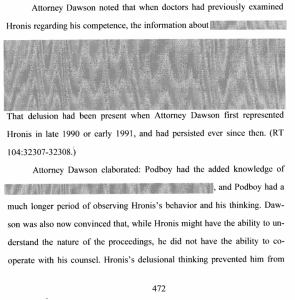
The court granted the request for separate 45-minute defense arguments, but denied the application for a closed courtroom. The order said, “Any argument concerning Claim V in Hronis’s briefing may be presented in open court, during which time any counsel may if necessary refer to matters disclosed in the unredacted briefing that has been filed under seal in this court.”